
You have already tried everything.
The breathing. The journaling. The apps. The reframing. And you are still anxious.
A 14-day Vipassana protocol for people whose anxiety has not responded to any of it.
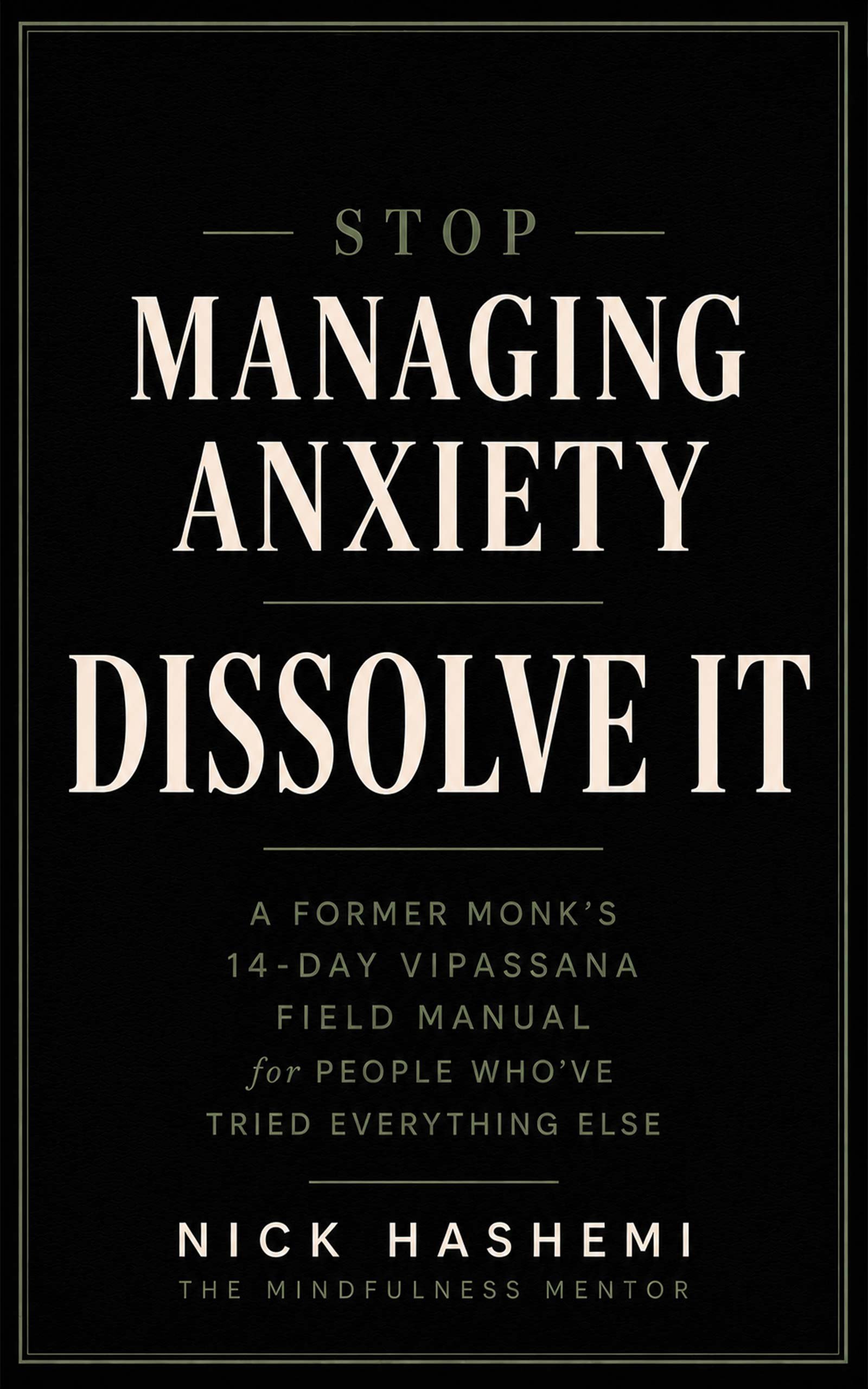
Most people who buy something about anxiety have already bought five other things about anxiety.
You know the 4-7-8 breath. You have grounded with your five senses. You have been told to sit with the feeling. Some of it helped for ten minutes. Some of it helped for thirty. The anxiety always came back, often louder, as if it had been offended by the attempt.
This is not because you did it wrong. It is not because you lack discipline.
It is because almost every approach to anxiety treats it as one thing.
It is not one thing. It is three.
Anxiety does not arrive through one mechanism. It arrives through three.
Spend enough hours watching the mind under controlled conditions and something becomes obvious. Each of the three needs a completely different response.
Apply a thinking-based technique to a body-based mechanism and nothing happens. Apply a body-based technique to a memory-based mechanism and nothing happens. You conclude that you are broken, or that meditation does not work for you.
Neither is true. You were using the wrong tool for the mechanism you have.
Three mechanisms. Three different responses.
The Spiral
One thought hooks into the next. By the time you notice, you are three steps into a future that has not happened and probably will not. It lives almost entirely in language. Distraction works until the distraction stops.
Standard advice tells you to challenge the thought. But every challenge is another thought, and the Spiral runs on thoughts. You are feeding the thing you are trying to stop.
The Surge
Nothing is happening. You are in a queue, or in bed, or halfway through a normal Tuesday. Then your chest tightens and your heart is going and your hands are tingling, and your mind scrambles to explain it after the fact.
Breathwork helps while you are doing it and stops helping the moment you stop. Every time you talk yourself down, your nervous system files the same conclusion: that sensation was dangerous and I survived it. So the alarm fires again.
The Echo
It is 2:47 in the morning. You are not worried about tomorrow. You are replaying something you said four months ago, and your face is hot in the dark.
You have tried to forgive yourself. You have decided intellectually that it does not matter. The body keeps reacting as though it does, because the story has been worked through and the sensation underneath it has not.
Not a meditation course. Not a book about anxiety. A protocol.
The manual is the map. The emails are the walking.
This is not new. It is roughly two and a half thousand years old.
Vipassana is not relaxation and it is not spirituality. It is a technique for observing how the mind constructs experience, developed and refined over centuries by people who did nothing else. They worked with the Spiral, the Surge and the Echo long before anyone had those words, and the responses they found still work.
What has been missing is the translation. Most of this material assumes you are on a cushion in a quiet room with nothing else to do. You have a job, a phone, and a calendar.
That translation is what this manual is.
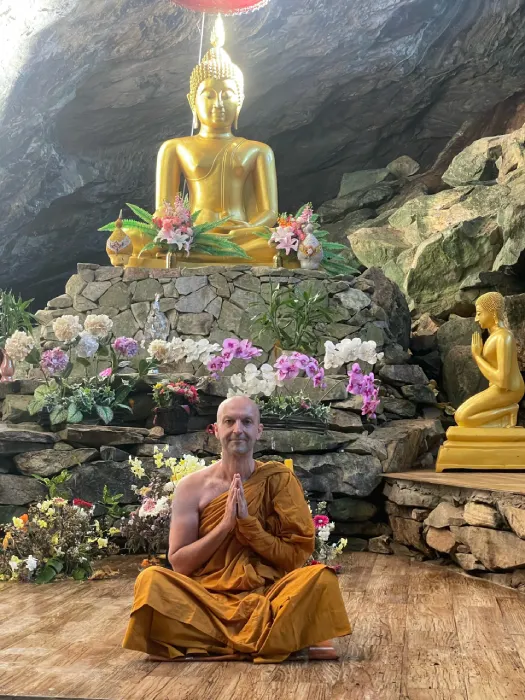
A path that few have walked.
Nick Hashemi spent more than twenty years building and running companies, including CXO roles across Europe and Southeast Asia.
Then he stopped.
He ordained as a Buddhist monk in Thailand and trained intensively in Vipassana under monastic discipline, learning firsthand how attention, emotion and the mind behave under pressure.
Today he writes for several thousand readers and works privately with a small number of students. This manual is the method he uses, written down.
From readers on Substack and students.
“I have been following you probably since you started. I have gained so much from your writings. Thank you so much!”
“Your writing stands out from all the noise in my email inbox and Substack feeds. Genuine writing from a genuine person.”
“I support your work Nick as I have found all of your writing not only so very moving but as a Mindful and Well-being Practitioner a form of writing that recognises our place on this planet and something that touches the soul with real truthful beauty. It’s a honour to have found you a true gift!”
Read this part honestly.
This is for you if:
This is not for you if:
Everything, for one payment.
Before you decide.
No. Day one asks you to sit for ten minutes without doing anything. Everything builds from there.
Ten to fifteen minutes a day for two weeks. Two days run to twenty and twenty-five minutes. Reading the manual takes an evening.
No. The technique comes from a Buddhist tradition, the same way antibiotics come from mould. What matters is whether it works.
You will. When it happens, do the next day. Do not try to catch up. The protocol is sequential by design.
No, and be careful of anything that says otherwise. Fourteen days is enough to recognise your mechanism, learn the response built for it, and see it start to shift. What happens after that depends on whether you keep practising.
Yes. Thirty days, no questions asked. Email contact@nickhashemi.com and it is done.
If you do the fourteen days and nothing shifts, you should not have paid for it.
Fourteen days. Fifteen minutes a day. A response built for the anxiety you actually have.
You have read this far, which probably means something in the three types was recognisable. That recognition is worth something on its own. Most people carry a mechanism for decades without ever seeing its shape.